PUBLIC RECORD — VOTER SERVICE
Confidential voter registration lasts four years. New York must now warn survivors before it expires.
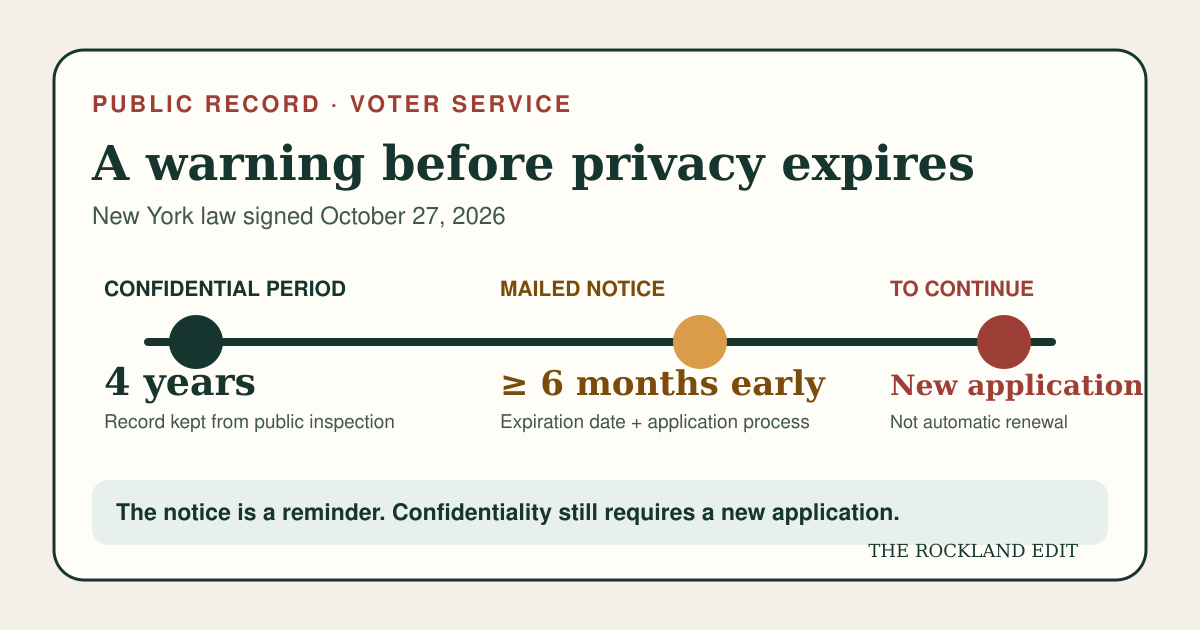
A law signed October 27 requires a mailed notice at least six months before a domestic-violence survivor's voter-record confidentiality period ends. The notice must state the expiration date and explain how to make a new application. It is a warning—not an automatic renewal.
The change in one minute
- Existing protection: an approved confidential-registration application keeps the voter record apart from public inspection for four years.
- New requirement: no later than six months before that period expires, election officials must mail the voter the expiration date and information about making a new application.
- Important limit: the law does not extend confidentiality automatically. Continuing it still requires a new application.
- Effective date: immediately upon becoming law October 27, 2026.
Who may apply for confidential registration
New York's current voter-registration guidance says a victim of domestic violence may submit a sworn statement to the local county board of elections stating that public access to the registration record would threaten physical or emotional harm to the voter, a family or household member. If granted, the registration record is kept separate from records open to public inspection for four years.
Open the State Board of Elections confidential-registration page and forms ↗. The page says a person who is not yet registered must register first. It currently provides the statement in English, Spanish, Bengali, Chinese, Korean, Malayalam, Tagalog and Urdu.
What the signed bill requires
S.9671-A/A.10960-A adds a notice rule to Election Law §5-508. Its enrolled text says that, no later than six months before confidentiality expires, the board of elections must mail the victim notice of the expiration date and information about the process for making a new application. The bill says the change takes effect immediately. Read the bill text and legislative record ↗
The statute says “the board of elections.” The current State guidance directs applications to the voter's local county board. This article does not add a mailing source or procedure that the signed text does not specify.
The notice is not the protection itself
A mailed reminder does not reveal whether a particular voter qualifies, whether an application will be granted or when a specific notice will arrive. It also does not replace the sworn statement. The practical value is earlier warning: a survivor should no longer reach the four-year end date without the advance notice the new law requires.
The State's public confidential-registration page still describes the existing four-year period and the option to reapply; it had not yet added the new six-month notice requirement when checked for this article. The forms remain the State's current public application route. That publication lag should not be read as a delay in the law's stated immediate effective date.
A separate confidential-ballot option also exists
New York's guidance separately describes a special ballot for a person who is a victim of domestic violence and has been forced to leave the residence. That ballot application follows Election Law §11-306 and is not the same document as the confidential-registration statement. Use the State page above to distinguish the two forms.
What this changes for a Rockland resident: a voter whose registration is confidential because of domestic violence should now receive a mailed warning at least six months before the four-year protection ends, including the end date and how to apply again. The warning does not renew confidentiality by itself.
Primary records: S.9671-A/A.10960-A bill text and legislative record ↗; Governor's October 27 signing announcement ↗; and the New York State Board of Elections confidential-registration page ↗. Checked October 27, 2026, at 10:54 a.m. EDT. This service article does not determine eligibility, confirm that an individual notice has been mailed or promise that an application will be approved. No survivor was contacted or identified.