PUBLIC RECORD — HEALTH RULE
New York declared flu prevalent. The health-care mask rule is now active.
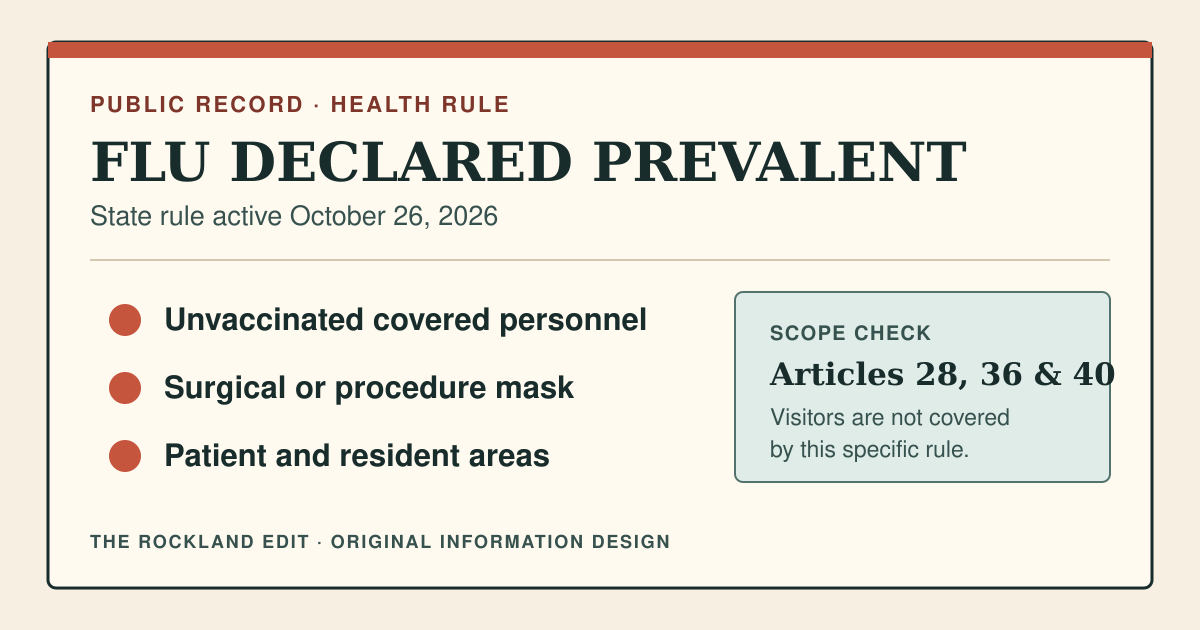
Since October 26, covered health and residential facilities and agencies must require personnel who are not vaccinated for this flu season to wear a surgical or procedure mask in areas where patients or residents are typically present.
The practical line
- Covered workplace: a facility or agency licensed under Article 28, 36 or 40 of New York's Public Health Law—such as a hospital, nursing home, diagnostic and treatment center, covered home-care agency or hospice.
- Covered person: paid or unpaid personnel who could expose patients or residents, including employees, medical and nursing staff, contractors, students and regular volunteers.
- Required action: if not vaccinated against flu for the current season, wear a surgical or procedure mask in areas where patients or residents are typically present.
- Visitors: this regulation does not itself impose a general visitor mask requirement. A facility may have a separate or stricter policy, so check before traveling.
Coverage follows the operating certificate—not the building's everyday name
The rule does not apply to every place that provides care. The Department's current page names facilities and agencies regulated under Public Health Law Articles 28, 36 and 40. Its linked FAQ gives hospitals, nursing homes, diagnostic and treatment centers, adult day health programs, covered home-care agencies and hospices as examples.
The same FAQ says assisted-living facilities, adult homes, private medical and therapist practices, Article 44 managed long-term-care programs, Article 31 mental-health facilities and consumer-directed personal assistants are not covered by this regulation unless the work or unit falls under a relevant Article 28, 36 or 40 operating certificate. A worker unsure about a Rockland employer should check the employer's current policy or operating-certificate status rather than guessing from the facility name.
Where the mask must be worn
The state FAQ lists patient or resident rooms, open nurses' stations, hallways and elevators where patients are typically present, patient-present cafeterias, reception areas and patients' homes during covered home care. The rule calls for a surgical or procedure mask; it does not require an N95 respirator by itself.
The requirement also applies when an unvaccinated covered worker has a medical contraindication to vaccination. The FAQ allows limited removal when necessary to provide speech therapy or communicate with someone who lip-reads. Facilities may adopt policies stricter than the statewide minimum.
The declaration is statewide, not a Rockland outbreak finding
The commissioner's October 26 advisory says New York recorded 3,526 laboratory-confirmed flu cases for the week ending October 17, with increased or sustained case counts in 59 of 62 counties. The advisory says that level of activity is unusual this early in the season.
Those statewide figures are not a Rockland case count, do not identify a Rockland facility outbreak and do not establish that a particular person has flu. They are the surveillance record the commissioner used to activate the statewide rule.
There is no fixed end date
The declaration remains in effect until the commissioner declares influenza no longer prevalent. The Department says its regulation page will be updated when the status changes. A worker, patient or visitor making a later-season plan should recheck the state page and the individual facility's policy.
What this changes for a Rockland resident: an unvaccinated employee, contractor, student or regular volunteer at a covered local facility should expect the facility's mask policy to be active now. A patient or visitor should not treat this state rule as a universal visitor mandate, but should still check the facility's own policy before arriving.
Primary records checked October 27, 2026, at 10 p.m. EDT: New York State Department of Health, current influenza-transmission regulation page ↗ and October 26 commissioner declaration ↗. Scope examples, visitor treatment, workplace-area examples and limited exceptions come from the Department's January 2, 2015 FAQ ↗, which the current state page still links; it is not a newly issued 2026 FAQ. This article does not determine a particular facility's license, employment status or individual medical needs.