PUBLIC RECORD — VOTER RIGHTS
At a Rockland poll site, a badge, a rumor or an observer cannot be used to stop you from voting.
New York's attorney general issued a statewide voter-rights advisory Tuesday: armed federal agents may not police polling places, poll watchers may observe but not interfere, and most New York voters are not required to show photo identification.
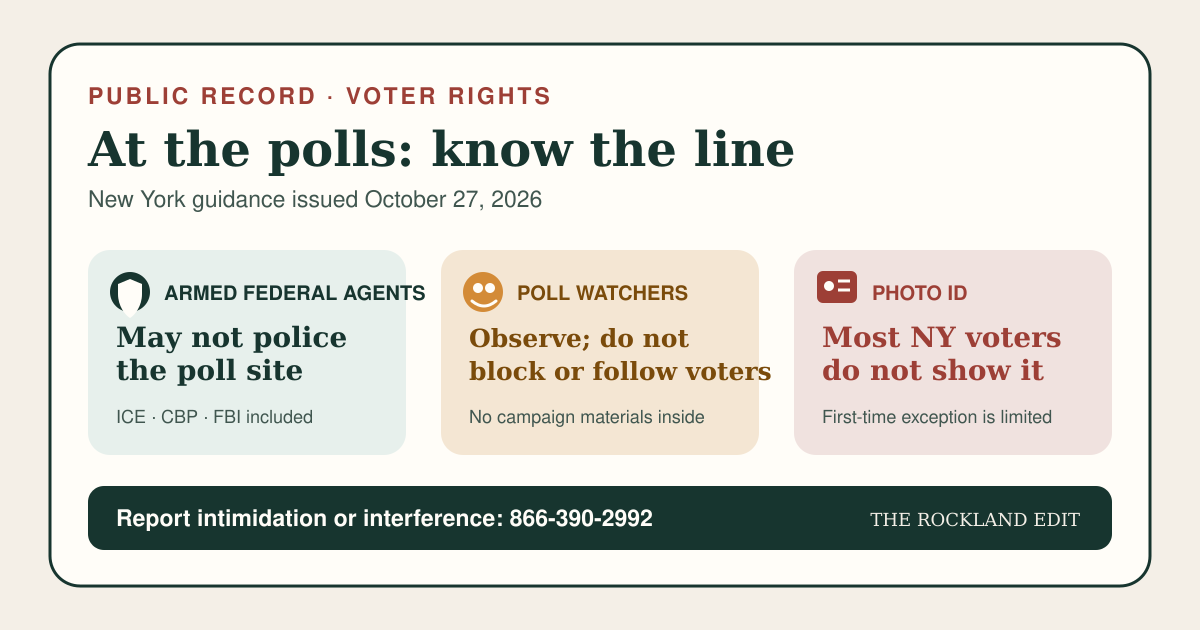
The line at the poll site
- Armed federal agents: the attorney general says federal law makes it a crime to order, bring or keep troops or armed federal officers—including ICE, CBP and FBI agents—at a poll site.
- Poll watchers: they may observe and report problems. They may not block voters, follow someone to the privacy booth or scanner, hand out campaign material, tamper with election materials or make repeated pretextual challenges.
- ID requests: most New York voters do not show photo ID. A first-time voter who did not provide identification when registering may be asked for an accepted document and may still use an affidavit ballot without one.
- Report interference: call the Office of the Attorney General's Election Protection Hotline at 866-390-2992 or use electionhotline.ag.ny.gov ↗.
Federal monitors and armed federal officers are not the same thing
The advisory says the U.S. Department of Justice may send election monitors to New York as part of a normal process. It says those monitors may not demand identification, challenge a voter, direct or interfere with poll workers, campaign or engage in political activity. The reviewed record does not confirm that monitors will be assigned to a Rockland location.
Separately, the attorney general says local governments in New York may not give immigration-enforcement officers access to a polling place for immigration enforcement unless the officers have a valid judicial warrant or court order. Anyone who believes a local official illegally collaborated with federal immigration enforcement may also use the attorney general's Office of Immigrant Trust complaint route.
What “no photo ID” means—and the first-time-voter exception
The state advisory says no one at a poll site may demand proof of citizenship and that eligible New York voters are not generally required to show photo ID. A first-time voter who did not provide identification when registering may be asked for identification. Accepted examples include a current utility bill, bank statement, paycheck, government check or another government document showing the voter's name and address; the document does not have to carry a photograph.
The advisory says a first-time voter without one of those documents may still cast an affidavit ballot and then follow up with the local board of elections to confirm identification. This article does not decide an individual registration or affidavit-ballot issue.
Assistance, privacy and the 100-foot rule
A voter who needs help because of a disability or difficulty reading or writing English may bring someone to assist throughout the voting process, including in the booth. The helper cannot be the voter's employer, union officer or an agent of either one. The advisory also says ballots are private, firearms are banned at polling places, and campaigning or telling someone how to vote is prohibited within 100 feet of the entrance.
If something happens
- If it is safe, note the time, location and what was said or done. Do not delay voting to gather evidence.
- Tell an election inspector at the site when the problem involves access, an improper challenge or interference.
- Report intimidation, interference or an improper ID demand to the attorney general at 866-390-2992 or through the online hotline.
- For potentially dangerous conduct, the attorney general directs voters to contact local law enforcement immediately.
Official Spanish-language version: the attorney general has published the same voter-rights advisory in Spanish ↗. Use that official translation for the state's full explanation and reporting instructions.
Election service update: early voting ended Sunday, November 1. Election Day is Tuesday, November 3, from 6 a.m. to 9 p.m. Vote at your assigned Election Day poll site—not a former early-voting center—and use the official state voter lookup ↗ before leaving. The Rockland County Board of Elections page ↗ also lists the Election Day hours and its polling-place lookup.
What this changes for a resident: fear of immigration enforcement, a badge, an observer or an improper ID demand should not be treated as a reason to stay home. The state has a direct reporting route, and its advisory spells out the limits that apply inside and around the poll site.
Primary records checked October 27, 2026, at 5:56 p.m. EDT: New York Office of the Attorney General, October 27 voter-rights advisory ↗, official Spanish-language advisory ↗ and two-page “Know your rights” guide ↗; Rockland County Board of Elections, 2026 early-voting schedule ↗. Election-service logistics were rechecked November 2, 2026, at 11:53 a.m. EST against the County's Election Day page ↗ and the State Board's voter lookup ↗; early voting ended November 1 and Election Day polls run from 6 a.m. to 9 p.m. at assigned sites. The Rockland Edit found no official record of a Rockland poll-site incident or federal-monitor assignment and does not imply one. This voter-service guide is general information, not an individual eligibility decision or legal advice.