PUBLIC RECORD — NY-17 ISSUE GUIDE
NY-17 and Medicaid: a vote, a rule and a promise are different things.
Health-care promises can sound alike until you look at the records behind them. For Rockland voters weighing Mike Lawler and Cait Conley, the coming Medicaid activity requirement offers one concrete place to start.
The state's October 7 amended certification ↗ lists Conley on the Democratic and Working Families lines and Lawler on the Republican and Conservative lines for the November 3 election. NY-17 includes Rockland County. This brief examines one Medicaid eligibility provision—not the candidates' entire health-care records.
What Lawler voted for
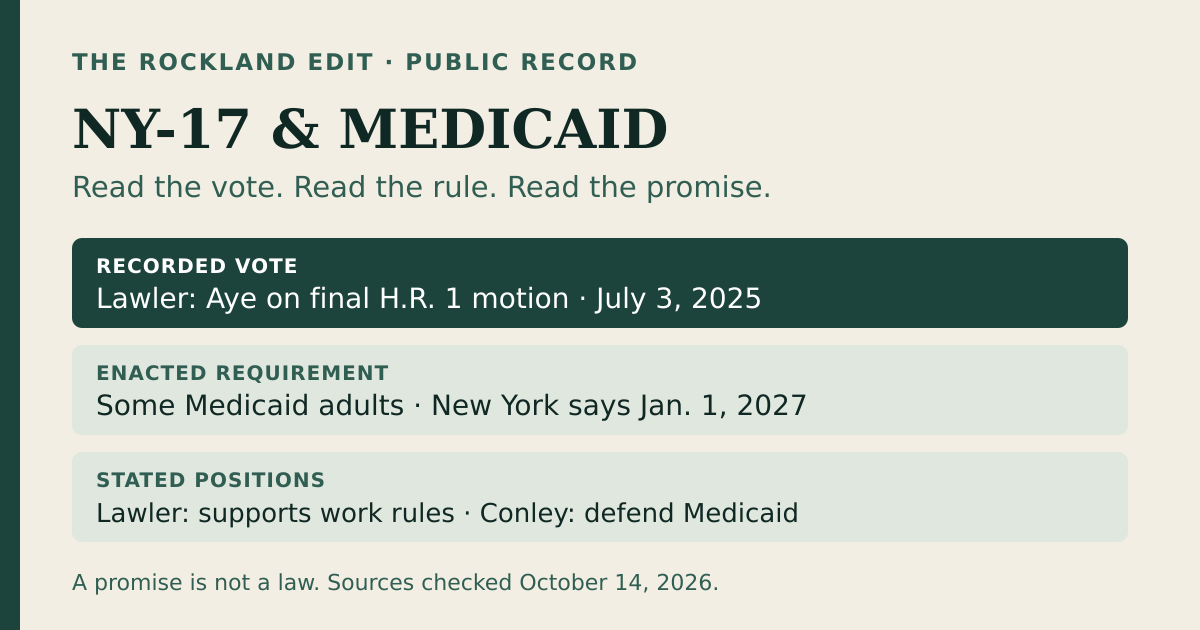
On July 3, 2025, Lawler voted Aye on the House motion to concur in the Senate amendment to H.R. 1. The House Clerk's roll call 190 ↗ records passage, 218–214. The measure became Public Law 119-21 ↗ on July 4. Section 71119 adds a community-engagement eligibility requirement for certain adults receiving Medicaid.
What the requirement actually says
New York's Medicaid Update ↗ currently says some members will need to meet the requirement starting January 1, 2027. It does not apply to everyone receiving Medicaid.
The CMS rule fact sheet ↗ describes affected adults as ages 19–64, not pregnant, not enrolled in or entitled to Medicare, and covered through the Medicaid adult group or certain demonstration programs. Qualifying routes include 80 hours of work, community service or eligible work-program activity per month; at least half-time education; or a monthly earnings threshold. Some activities can be combined.
Exemptions include pregnancy or postpartum coverage, medical frailty and certain caregivers, among other categories. These are broad summaries, not a determination of a reader's eligibility or reporting obligations.
There is also a legal challenge to parts of the implementation rule. New York joined the states' June 29 lawsuit ↗. A federal judge denied preliminary relief on July 29 ↗, without deciding the merits. An October 8 court notice ↗ schedules a hearing for October 22. A pending challenge is not itself a ruling that stops the requirement.
What Lawler says now
On his official health-care page ↗, Lawler says he supports work requirements for able-bodied adults without young children. He describes protecting Medicaid for vulnerable people as a priority and calls work, volunteering or school for 20 hours a week reasonable.
That is his stated rationale. The federal rule's main activity threshold is monthly, with other qualifying routes and exemptions; his weekly description should not replace the actual eligibility instructions.
What Conley proposes—and what this page does not establish
Conley's campaign policy page ↗ pledges to defend Medicaid and the Affordable Care Act, offer a public insurance option regardless of age, and expand Medicare to include vision, dental and hearing benefits. Those are proposals, not new benefits available to enroll in today.
The health-care section we reviewed does not explicitly address repeal of Section 71119. We do not infer her position on that specific provision from a broader Medicaid pledge. That is a limit of this source—not a claim that she has never addressed the question elsewhere.
The distinction to keep in mind
A roll call shows how an incumbent voted. Enacted text establishes the law. A candidate's own page establishes what that candidate says—not independent proof of savings, coverage outcomes or credit for funding. Those wider claims need their own records.
For coverage decisions, follow official notices from NY State of Health and current state guidance. This election guide does not determine anyone's eligibility or provide a complete reporting process.
Sources checked October 14, 2026: NYS Board of Elections certification, printed page 12; House Clerk roll call 190; Public Law 119-21, §71119, 139 Stat. 306–307; CMS's June 1 rule fact sheet; New York's July Medicaid Update, revised September; the linked court records; and the two candidate-authored pages. Candidate pages are undated live statements. No interview, local coverage-loss estimate, endorsement or prediction is represented. Court documents are linked as public records hosted by Georgetown's Health Care Litigation Tracker.