PUBLIC RECORD — NY-17 ISSUE GUIDE
NY-17 and SALT: a higher deduction cap is not repeal.
In the NY-17 race, raising the SALT cap and ending it describe different policies. For Rockland residents who pay state income or local property taxes, that distinction is worth keeping clear.
The state's October 7 amended certification ↗ lists Mike Lawler on the Republican and Conservative lines and Cait Conley on the Democratic and Working Families lines for the November 3 election. NY-17 includes Rockland County. This guide examines the SALT provision, not every tax policy in the race.
First, a deduction is not a refund
SALT means state and local taxes. Eligible taxes can be claimed as an itemized deduction on a federal return ↗, subject to limits. A deduction reduces income subject to tax; it is not a dollar-for-dollar refund or a reduction in the bill from your town, school district or county. The IRS explains the choice between standard and itemized deductions ↗. Taking the standard deduction does not also let a filer claim this Schedule A deduction.
What Lawler voted for
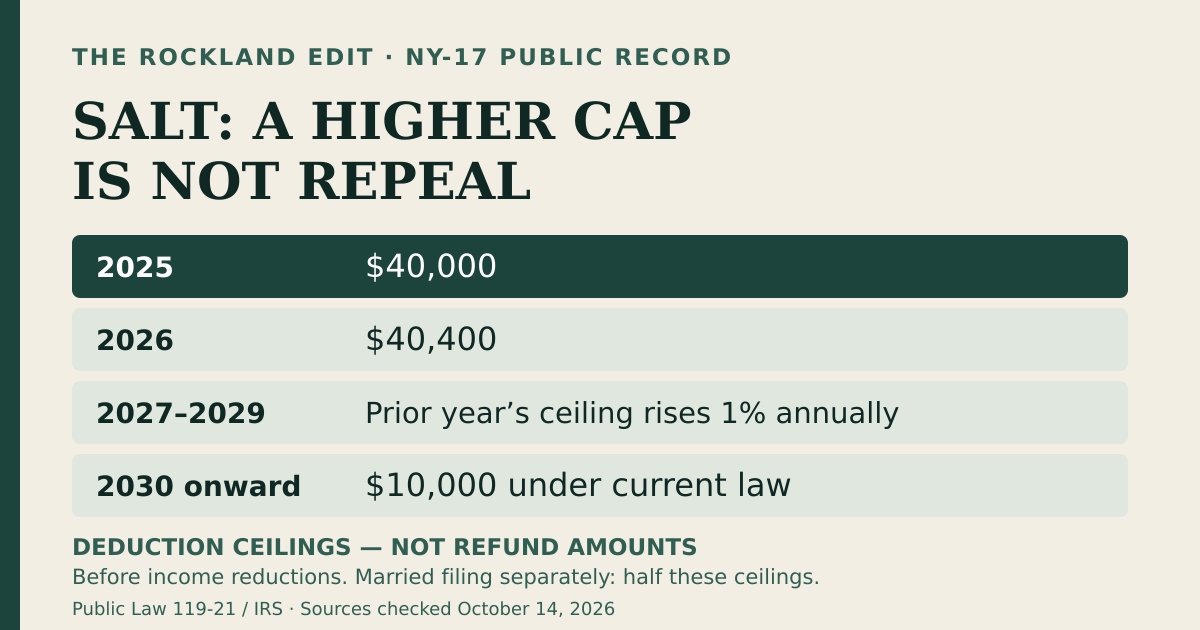
Lawler voted Aye on the July 3, 2025 House motion to concur in the Senate amendment to H.R. 1. The Clerk's roll call 190 ↗ records passage, 218–214. It became Public Law 119-21 ↗ the next day. Section 70120 continues the SALT cap beyond its former end date and temporarily increases the ceiling.
| Tax year | Ceiling under current law |
|---|---|
| 2025 | $40,000 |
| 2026 | $40,400 |
| 2027–2029 | Prior year's amount increases 1% each year |
| 2030 onward | $10,000 |
The ceiling is halved for married people filing separately. For tax year 2026, the IRS's corrected 1040-ES reminder ↗ says the limit starts shrinking when modified adjusted gross income exceeds $505,000, or $252,500 for separate filers, but does not fall below $10,000 or $5,000 respectively. Publication 505 for 2026 ↗ confirms those figures. They are limits and thresholds—not a promise that every household can deduct the full amount.
How the candidates describe it
Lawler's official tax page ↗ presents the move from $10,000 to $40,000 as an achievement. The enacted text supports a higher ceiling for the stated years. It does not eliminate the cap or guarantee the same savings for every Rockland household. His vote is documented; that record alone does not establish sole credit for negotiating the change.
Conley's campaign platform ↗ proposes eliminating the cap entirely. It also criticizes Lawler for voting to make the cap ongoing. The law removes the previous sunset while setting a return to $10,000 from 2030. A higher temporary ceiling and an ongoing underlying cap can both be true. Her proposed repeal is a different policy; it has not become law.
The question behind the headline
Which tax year? Which filing status? How much eligible tax? Does the filer itemize, and do income limits apply? Those questions matter more to an individual outcome than the largest number in a campaign statement.
This is a voter-facing explanation, not individualized tax advice. It does not estimate a reader's savings, compare every provision of the law, or determine a filing choice. Wider claims about average savings and the share of district residents benefiting require their own data and assumptions.
More in our NY-17 issue guides: Medicaid: Lawler's vote, the coming rule and Conley's published commitments →
Sources checked October 14, 2026: NYS BOE certification, printed page 12; House Clerk roll 190, July 3, 2025; Public Law 119-21, July 4, 2025, §70120 at 139 Stat. 169–170/PDF pages 99–100; the explicit 2026 IRS correction and Publication 505; IRS itemization guidance; and the two candidate-authored pages, which are undated live statements. The higher-cap schedule is not a permanent $40,000 deduction. Campaign motive allegations, unverified district savings estimates and predictions of repeal passing are excluded. No interview, endorsement or individualized return calculation is represented.