PUBLIC RECORD — ORANGETOWN PROPOSITION 2
Orangetown's transfer-tax question: what a buyer would pay—and when.
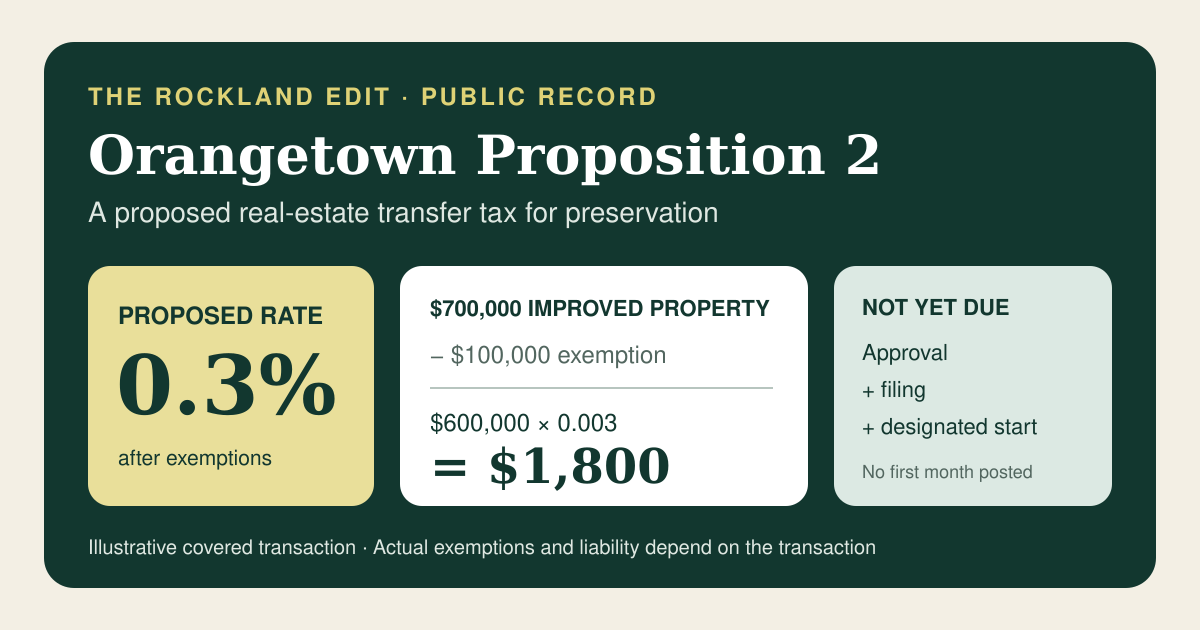
Orangetown voters will decide whether to authorize a one-time real-estate transfer tax for the Town's Community Preservation Fund. The Town chose a rate of 0.3%, but the operative law includes exemptions and start conditions. A Yes vote would authorize the charge; it would not make it collectible on Election Day.
What the ballot asks
Proposition 2 asks whether Orangetown may create a 0.3% transfer tax on covered real-property conveyances and deposit the revenue in its Community Preservation Fund. The official question says the fund is for purposes including natural areas, water quality, trees and woods, wildlife habitat, parks, historic resources and working farms.
A Yes vote authorizes the local law, subject to filing and commencement requirements. A No vote does not authorize this proposed charge. This guide explains the public record; it does not recommend either vote.
A simple improved-property example
For an improved property, the law exempts the first $100,000 of consideration. On a hypothetical $700,000 covered transaction, the simple arithmetic is:
| Step | Amount |
|---|---|
| Consideration in the example | $700,000 |
| Improved-property exemption | − $100,000 |
| Illustrative taxable amount | $600,000 |
| 0.3% of $600,000 | $1,800 |
The same calculation produces $1,200 on a $500,000 improved-property transaction and $2,700 on a $1 million one. Those are examples, not quotes for a closing. For unimproved property, the consideration exemption is $50,000, not $100,000. The state and local laws also contain transaction-specific exemptions, so price alone cannot establish liability.
Who pays under the operative law?
The ballot describes the tax as paid by the purchaser. The enacted local-law text is more precise: it assigns liability first to the grantee. If the grantee fails to pay or is exempt, the law assigns payment to the grantor. That fallback is why “the buyer always pays” would overstate the rule.
The local law also excludes qualifying conveyances made under a binding written contract entered before the tax's effective date. Whether a particular agreement or transfer qualifies is a transaction-specific legal and tax question.
A Yes vote would not start collection on November 3
Three records must stay separate. The Town Board adopted Local Law 3-C on July 14; voters now decide whether to approve it; and collection has its own commencement rule. The local law says it takes effect after an affirmative vote and filing with the Secretary of State. The state enabling law says the tax applies starting on the first day of a month designated by the Town Board, not less than 60 days after enactment.
No official record reviewed for this guide designates a first taxable month. That means Election Day is neither a verified collection date nor a basis for adding the charge to a current closing estimate.
What the fund could do—and who decides
State law restricts the fund to projects identified in the Town's adopted community-preservation plan. An advisory board reviews and recommends; the Town Board makes acquisition decisions. Before an acquisition, the statute requires a public hearing and written findings. Listing a parcel in a plan does not mean the Town has bought it, protected it or committed tax revenue to it.
The ballot says state and federal money may match fund revenue. “May” matters: voter approval would not itself award a grant or guarantee a match. It also would not establish how much the tax will collect.
What changes for an Orangetown voter: Proposition 2 presents a real choice about authorizing a preservation-dedicated transfer tax. The clearest cost example is 0.3% after the applicable consideration exemption, but actual liability depends on the property and transaction—and no collection start has yet been designated.
Primary records checked October 23, 2026: Rockland County Board of Elections' Proposition 2 listing ↗ and the Town's official ballot abstract ↗; Orangetown Local Law 3-C ↗; New York Tax Law §1439-bbb*2 ↗, Tax Law §1439-eee*2 ↗ and Town Law §64-l*2 ↗. The Town's explanatory page advocates for the proposition; this guide relies on the ballot and operative law for legal claims. It is not individualized tax, legal or closing advice.