PUBLIC RECORD — NY-17 ISSUE GUIDE
On Iran war powers, six votes are clearer than the legal effect.
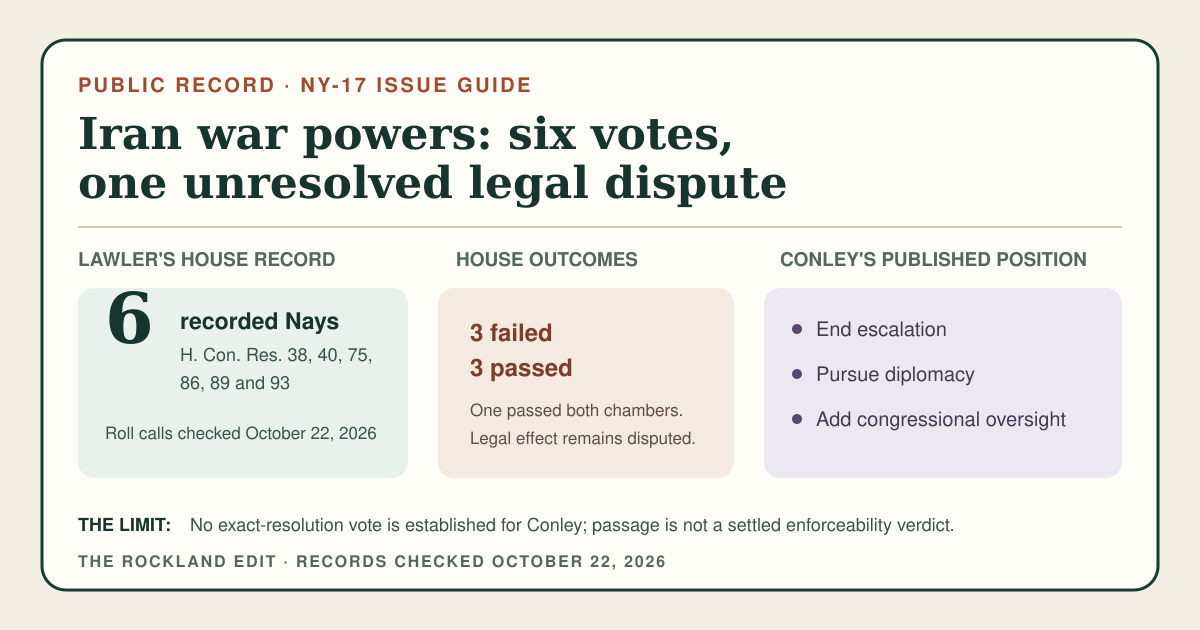
Mike Lawler voted Nay on six House resolutions directing withdrawal from Iran hostilities in 2026. Cait Conley proposes ending military escalation, pursuing diplomacy and adding congressional oversight, but the reviewed record does not show how she would vote on any of those exact measures.
The state's October 7 amended certification ↗ lists Cait Conley on the Democratic and Working Families lines and Mike Lawler on the Republican and Conservative lines for the November 3 election. Those are two candidates on four party lines. NY-17 includes all of Rockland County.
Lawler voted Nay six times
House Clerk records show the same result for Lawler across this defined family of six Iran-withdrawal concurrent resolutions: Nay. Three measures failed in the House; three passed it.
| Measure and House vote | Lawler | House result | Later verified action |
|---|---|---|---|
| H. Con. Res. 38, March 5 ↗ | Nay | Failed, 212–219 | No House passage |
| H. Con. Res. 40, April 16 ↗ | Nay | Failed, 213–214 | No House passage |
| H. Con. Res. 75, May 14 ↗ | Nay | Failed, 212–212 | No House passage |
| H. Con. Res. 86, June 3 ↗ | Nay | Passed, 215–208 | Senate passed June 23, 50–48 |
| H. Con. Res. 89, July 23 ↗ | Nay | Passed, 214–208 | Senate rejected September 24, 49–50 |
| H. Con. Res. 93, September 15 ↗ | Nay | Passed, 220–204 | Referred to Senate Foreign Relations September 16 |
The October 22 House calendar history ↗ supplies the later-action column. It records no action on H. Con. Res. 93 after its September 16 Senate referral. That is a dated status check, not a prediction that the Senate will not act.
What the latest resolution said
The House-passed H. Con. Res. 93 text ↗ would direct removal of U.S. forces from hostilities within or against Iran under section 5(c) of the War Powers Resolution. It included exceptions for forces needed to defend the United States, an ally or a partner from imminent attack—subject to the resolution's section 5(b) condition—and for hostilities expressly authorized by a declaration of war or a specific Iran authorization.
Lawler's Nay was a vote against that complete text. It was not a separate vote on each condition. And it does not by itself prove why he voted that way.
Lawler's explanation is broader than any one resolution
In an October 8 interview published by the New York Editorial Board ↗, Lawler acknowledged voting against withdrawal efforts and argued that threats to shipping, U.S. bases and allies had to be addressed. In an October 9 River Journal questionnaire ↗, he again tied ending engagement to shipping, nuclear and allied-security concerns.
Neither published answer identifies one of the six resolutions or analyzes its exact defense and authorization conditions. The Rockland Edit therefore presents those statements as his broad rationale, not as a clause-by-clause explanation of H. Con. Res. 93. The publishers' accounts are not interviews conducted by this newsroom.
What Conley proposes—and what is still missing
Conley's campaign policy page ↗ says she would end military escalation with Iran, pursue diplomacy to prevent an Iranian nuclear weapon and enact congressional oversight of presidential military action. Her River Journal answer calls for ending the war.
Those statements establish a policy direction, not a recorded vote. The reviewed material does not name any of the six resolutions, address their precise conditions or promise a Yea vote. We do not manufacture that commitment for her.
Passing both chambers did not settle legal effect
H. Con. Res. 86 passed both chambers. But a concurrent resolution is not a bill or joint resolution presented for presidential signature. The current official U.S. Code text for 50 U.S.C. § 1544 ↗ still prints section 5(c), which says forces shall be removed when Congress so directs by concurrent resolution.
The executive branch disputes that mechanism. In its September 15 statement opposing H. Con. Res. 93 ↗, the administration argued that a concurrent resolution lacks legal force and would be an unconstitutional legislative veto under INS v. Chadha. That is the administration's legal position—not a court ruling about these measures or proof that congressional action had no consequence.
The careful bottom line
Voters can verify Lawler's six Nays and Conley's broader escalation, diplomacy and oversight proposals. They should not confuse the votes with a declaration of war, a new authorization, proof of completed withdrawal or a settled constitutional judgment.
This guide does not report present operations, casualties, gasoline prices or an individual service member's obligations. It does not provide legal advice or endorse a candidate.
More in our NY-17 issue guides: Indian Point: candidate positions are not operating authority → · Haitian TPS: separate a House vote from present status → · Congressional stock trading: a vote and a divestment proposal are different records →
Sources checked October 22, 2026: New York's October 7 amended election certification; House Clerk rolls 85, 114, 170, 199, 282 and 307; GPO's October 22 House calendar and House-passed H. Con. Res. 93; current 50 U.S.C. §§ 1544 and 1547, each showing laws in effect through Public Law 119-121; the administration's September 15 statement; Conley's current policy page; and the two publisher interviews linked above. Official records control votes, text, disposition and statutory wording. Candidate and publisher pages establish attributed positions only. No current operational finding, constitutional verdict, interview, endorsement or prediction is represented.