PUBLIC RECORD — NY-17 ISSUE GUIDE
On Haitian TPS, a House vote did not restore protection.
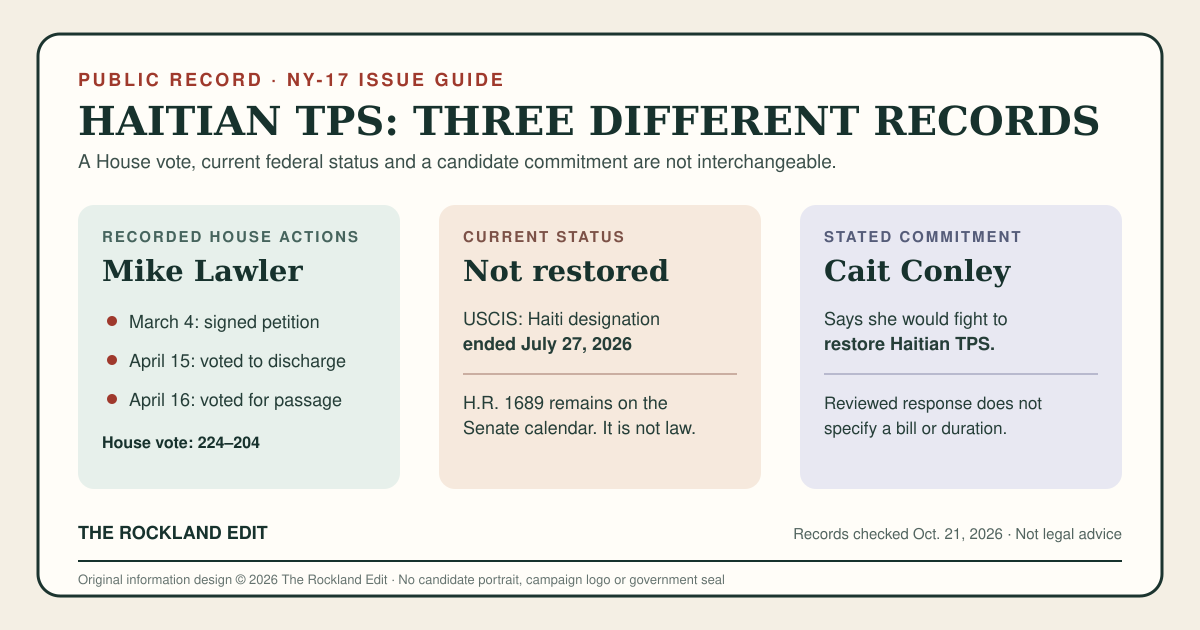
Mike Lawler helped force and pass a House bill that would require a new Haiti TPS designation. Cait Conley says she would fight to restore Haitian TPS. Current federal guidance says the designation ended July 27, and the House bill has not become law.
The state's October 7 amended certification ↗ lists Cait Conley on the Democratic and Working Families lines and Mike Lawler on the Republican and Conservative lines for the November 3 election. Those are two candidates on four party lines. NY-17 includes all of Rockland County.
Start with the current federal status
Temporary Protected Status is a federal, country-based humanitarian protection. It does not itself create permanent immigration status. The current USCIS country table ↗ says Haiti's TPS designation was terminated effective July 27, 2026.
The termination had been paused during litigation. On June 25, the Supreme Court held ↗ that the plaintiffs challenging the Haiti and Syria terminations were not entitled to orders postponing them while the cases proceeded. The Court's docket ↗ records judgment issued July 27.
Those records do not decide any one person's asylum application, other immigration status, work authorization, removal defense or deadline. They also do not establish that conditions in Haiti are safe.
What Lawler actually did in the House
Lawler signed Discharge Petition No. 15 ↗ on March 4. That petition sought to move the rule for H.R. 1689 out of committee; signing it was not a vote on final passage.
On April 15, Lawler voted Yea on the motion to discharge the rule. The Clerk records that motion passing 219–209 ↗. The next day, he voted Yea on the rule, which passed 220–207, and then voted Yea on H.R. 1689 itself. The final passage vote was 224–204 ↗.
| Record | Documented fact | What it did not do |
|---|---|---|
| March 4 petition | Lawler signed the petition to discharge the rule for H.R. 1689. | It did not pass the bill or restore TPS. |
| April 15 procedure | Lawler voted Yea; the motion to discharge passed 219–209. | It was not the final passage vote. |
| April 16 passage | Lawler voted Yea; H.R. 1689 passed the House 224–204. | House passage alone did not make it law. |
| Current Senate calendar | H.R. 1689 remains listed as Order No. 374. | Calendar placement is not Senate passage or enactment. |
| Conley's response | She says she would fight to restore Haitian TPS. | The reviewed response does not specify a bill, duration or mechanism. |
What the House-passed bill would require
The House-passed text ↗ is brief. It would require the Homeland Security secretary to designate Haiti for TPS until the date three months after January 20, 2029. That is the bill's own wording; this guide does not replace it with an estimated end date.
The bill is not law. The latest posted Senate calendar ↗, dated October 22 and checked October 21, still lists H.R. 1689 as Order No. 374, read a second time and placed on the calendar April 21. That is a current status checkpoint—not a prediction about what the Senate will do.
What Conley says
In an October 9 River Journal candidate questionnaire ↗, Conley says she would fight to restore Haitian TPS. The outlet says it asked both candidates the questions and edited their responses for length and conformity.
That establishes a stated commitment, not a congressional vote or enacted protection. The reviewed answer does not identify H.R. 1689, commit to its precise duration or explain the legislative or administrative mechanism she would use. We do not fill those gaps for her.
This is not a manufactured disagreement
Both records point toward renewed protection. The meaningful comparison is therefore not “for versus against.” Lawler has a documented petition signature and House votes on a specific bill. Conley has a published future commitment without a recorded congressional vote. Voters can weigh those different records while keeping present law separate from both.
For an individual case
This article cannot determine anyone's lawful presence, work authorization, eligibility for another status or legal deadline. Use current USCIS notices and consult a qualified immigration lawyer or a Justice Department-accredited representative for advice about a specific case.
More in our NY-17 issue guides: Congressional stock trading: the bill and proposal are not the same policy → · SALT: a higher deduction cap is not repeal → · Medicaid: separate the vote, the rule and the promise →
Sources checked October 21, 2026: the NYS Board of Elections' October 7 amended certification; House Clerk Discharge Petition No. 15 and rolls 113, 119 and 120; the House-passed H.R. 1689 text; GPO's latest posted Senate calendar, dated October 22; the Supreme Court's June 25 opinion and July 27 judgment entry in Mullin v. Doe; USCIS's current TPS table and July 29 I-9 update; and River Journal's October 9 candidate questionnaire. Official records control the votes, bill and federal status; the questionnaire establishes candidate statements only. No interview, individual legal conclusion, countywide TPS-holder count, endorsement or prediction is represented.