PUBLIC RECORD — NY-17 ISSUE GUIDE
On congressional stock trading, the details matter.
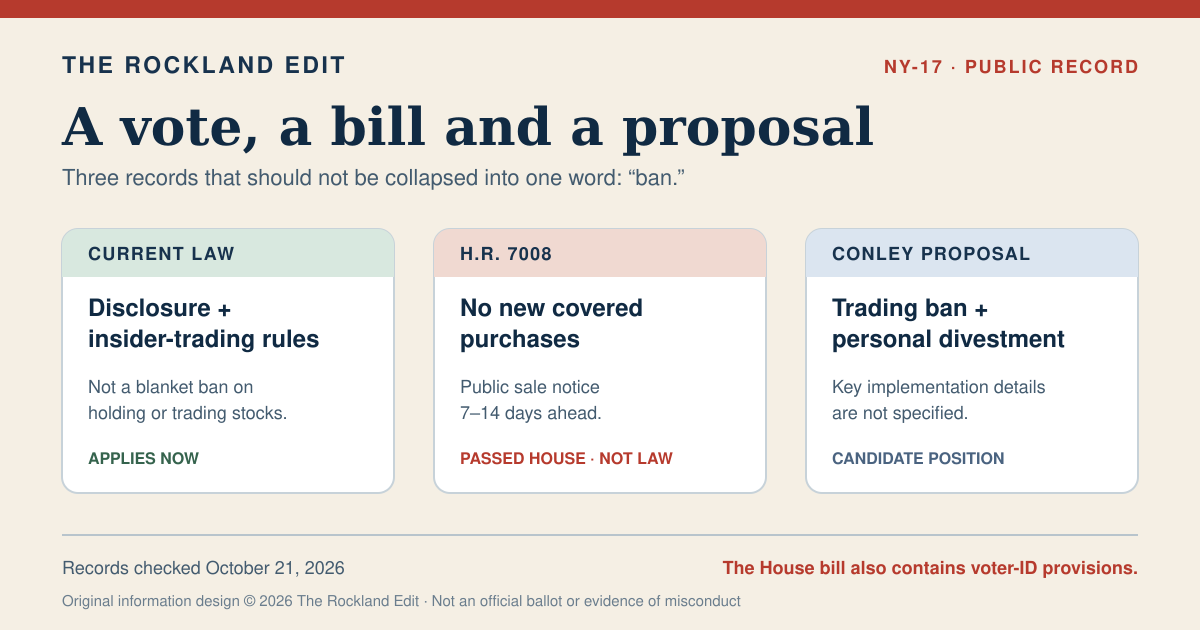
Voters hear the word “ban.” The records show three different things: rules that already apply, the House bill Mike Lawler voted for and the personal-divestment proposal Cait Conley has published.
The state's October 7 amended certification ↗ lists Cait Conley on the Democratic and Working Families lines and Mike Lawler on the Republican and Conservative lines for the November 3 election. Those are two candidates on four party lines. NY-17 includes Rockland County.
What current law already does
The STOCK Act ↗ says Members of Congress are not exempt from federal insider-trading prohibitions and establishes a duty concerning material nonpublic information gained through congressional work. Current law also requires covered House filers to report certain securities transactions over $1,000 involving themselves, a spouse or a dependent child. The deadline is the earlier of 30 days after learning of the transaction or 45 days after it occurred.
Those are important rules, but they are not a blanket prohibition on owning or trading individual stocks. A disclosed transaction is not, by itself, proof that it was lawful, unlawful or based on inside information.
What Lawler voted for
Lawler was an original cosponsor of H.R. 7008 ↗ and voted Yea when the House passed it on July 22. The Clerk's roll call 280 ↗ records passage, 232–198. The controlling House-passed text ↗ would cover Members, their spouses and dependent children.
It would prohibit new purchases of securities issued by publicly traded companies and comparable synthetic interests, subject to defined exclusions and exceptions. A covered sale would require public notice at least seven and no more than 14 calendar days before the transaction. The bill does not generally require existing holdings to be sold; forced sale applies to an investment purchased in violation.
| Question | Documented answer | Status |
|---|---|---|
| Insider trading and disclosure | Current law bars insider trading and requires reports for certain covered transactions over $1,000. | Applies now |
| New covered purchases | H.R. 7008 would prohibit them for Members, spouses and dependent children, with exclusions and exceptions. | Passed House; not law |
| Covered sales | H.R. 7008 would require public notice 7–14 calendar days in advance. | Passed House; not law |
| Existing holdings | H.R. 7008 has no general divestment requirement; it requires sale of an investment bought in violation. | Passed House; not law |
| Conley's position | Her policy page proposes a congressional trading ban and personal divestment from holdings. | Candidate proposal |
| Voter-ID provisions | H.R. 7008 also contains federal voter-ID language for federal elections. | Passed House; not current voting rules |
The bill's exceptions matter. A spouse or dependent child could trade in defined circumstances tied to employment, fiduciary duties or an occupation. Automatic or immediate reinvestment of dividends into the same covered investment is excepted from the purchase restriction. Funds and trusts must meet the bill's definitions; this is not a one-word ban on every investment.
Violations would trigger a fee set by the supervising ethics office: the greater of $2,000 or 10% of the transaction value, plus any net gain calculated under the bill. That enforcement structure is part of the House proposal, not current law.
Conley proposes going further on existing holdings
Conley's campaign policy page ↗ says she would ban Members of Congress from trading stocks while in office and require personal divestment from holdings. The divestment promise reaches a question H.R. 7008 does not generally answer: what to do with investments already owned.
The reviewed campaign material does not specify which assets must be sold, whether the requirement would extend to spouses or dependent children, whether a qualified blind trust would satisfy it, the deadline, the enforcement mechanism or Conley's position on H.R. 7008's voter-ID section. Those are unresolved details, not reasons to fill in an answer for her.
Lawler's vote covered more than stock trading
H.R. 7008 also includes federal voter-ID provisions. They would take effect only after enactment and under the bill's own timetable. They are not the rules Rockland voters should use for the November 3 election; follow current instructions from the Rockland County Board of Elections ↗.
Before final passage, Lawler voted Nay on a simple motion to send the bill back to committee. The Clerk records that motion failing 211–218 ↗. A broader alternative was printed in the Congressional Record, but the House did not take a direct amendment vote on it. Lawler's documented sequence is therefore a vote against recommittal and a vote for the final bundled bill—not a separate roll call on that alternative text.
Where the bill stands
H.R. 7008 is not law. On September 30, the Senate rejected cloture on the motion to proceed, 53–47; the vote required three-fifths. The October 22 Senate calendar ↗ still lists the bill as Order No. 548. The Senate's current schedule says no substantive business is expected before the November 3 election. That does not make the bill dead or legally prevent later action.
The useful distinction
Lawler has a recorded vote for a specific House bill. Conley has a published proposal that includes personal divestment but leaves implementation details open. Voters can compare those records without treating either one as enacted law—or as evidence of misconduct.
More in our NY-17 issue guides: SALT: a higher deduction cap is not repeal → · Medicaid: separate the vote, the rule and the promise →
Sources checked October 21, 2026: the NYS Board of Elections' October 7 amended certification; the STOCK Act and current Title 5 reporting provisions; House Ethics' April 15 instruction guide; H.R. 7008's January 12 introduced-bill record and July 22 House-passed text; House Clerk rolls 279 and 280; GPO's October 22 Senate calendar; the Senate's September 30 roll call and current schedule; and the candidates' linked first-party pages. Candidate pages establish stated positions only. No personal financial records were reviewed, and no holding, trade, compliance finding, endorsement, interview or prediction is represented.